Free to start · Not medical advice

Health Library
AutoimmuneCondition family guide

Myositis

Myositis means inflammation of the muscles you use to move your body. An injury, infection, or autoimmune disease can cause it. Two autoimmune forms are polymyositis, which weakens the muscles closest to the trunk, and dermatomyositis, which also causes a skin rash. There is no cure for these diseases, but symptoms can be treated.

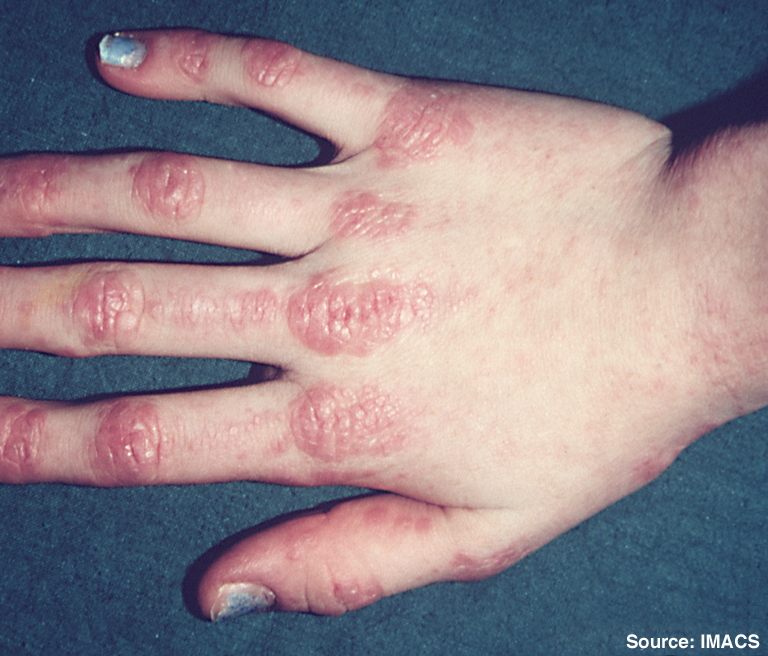
Myositis — educational image

Image: Elizabeth M. Dugan, Adam M. Huber, Frederick W. Miller, Lisa G. Rider · CC BY-SA 3.0 · Source

Clinically reviewed

This source-backed guide has completed independent clinical review.

Common signs and symptoms

Muscle weakness is the main symptom.

  • Polymyositis usually weakens the muscles closest to the trunk of the body.
  • Feeling tired after walking or standing, and tripping or falling.
  • Trouble swallowing or breathing in some people.
  • In dermatomyositis, a skin rash appears along with muscle weakness.

Sources [1]

What may contribute

Muscle inflammation has several possible causes.

  • An injury or an infection can inflame muscles.
  • Polymyositis and dermatomyositis are forms caused by the immune system attacking the body.
  • Specialists group these inflammatory muscle diseases into subtypes to guide evaluation and care.

Sources [1], [2]

How it is evaluated

Doctors usually combine several types of tests.

  • A physical exam checks muscle strength and the skin.
  • Lab tests, including blood tests, look for signs of muscle inflammation.
  • Imaging tests can look at the muscles, and a muscle biopsy may be taken.
  • Classification criteria combine the pattern of weakness, skin signs, lab results, and biopsy findings.

Sources [1], [2]

Treatment and ongoing care

There is no cure, but treatment can control symptoms.

  • Polymyositis and dermatomyositis are usually treated first with high doses of a corticosteroid.
  • Other medicines may be added as part of ongoing care.
  • Physical therapy, exercise, heat therapy, assistive devices, and rest are also used.

Sources [1]

Day-to-day support

Everyday adjustments support medical treatment.

  • Follow the exercise and physical therapy plan from your care team.
  • Use assistive devices and balance activity with rest to manage fatigue.
  • Keep notes on changes in strength, such as trouble with stairs or getting up from a chair, to share at visits.

Sources [1]

When to seek prompt help

Weakness that affects swallowing or breathing needs prompt care.

  • Seek prompt care for new or worsening trouble swallowing, or choking when eating or drinking.
  • Call 911 for difficulty breathing.
  • Report rapidly worsening weakness or new falls to your care team promptly.

Sources [1]

Research basis

Sources and review status

Sources were checked on October 16, 2026. This guide is version 2026.10. This source-backed guide has completed independent clinical review.

  1. [1]
    Myositis

    MedlinePlus, U.S. National Library of Medicine

Commonly involved specialists

These are the types of clinicians who are frequently involved in evaluating or supporting this condition.

RheumatologistNeurologistDermatologistPhysical therapist

Factors to discuss with a qualified professional

Bringing organized notes on these topics can help make your appointment more focused.

  • Which everyday tasks have become harder, such as climbing stairs
  • Any new rash and where it appears
  • Any trouble swallowing or breathing
  • Falls or near-falls you have had

Things you might track over time

A symptom journal can help you and your clinician review patterns together.

Muscle strength
Fatigue after activity
Swallowing difficulty
Skin rash

This information is educational and does not provide a diagnosis or treatment plan. Discuss your individual situation with a qualified healthcare professional.

Find specialists near you

Search our directory of US doctors for the specialists commonly involved in myositis care, then add your state or city.

Open Find Care